
A garden frost alert measured right at plant level
Senzor with the SHT40 air sensor measures temperature at plant height and turns on a frost alert in Home Assistant when it drops below your threshold. Hysteresis keeps it from flapping on and off when the temperature hovers around the limit.
- Works with Home Assistant
- Open source
- No cloud
For this use case you need the Senzor temperature probe device.
A pre-order costs nothing. You pay after we e-mail you that your device from the first batch is ready to ship, and you can cancel until then.

Illustration of use. Photos will follow from the first batch. See the enclosure
How it works and how it connects

- A stainless probe measures temperature in the middle of the compost or in the soil, and an SHT40 sensor measures air temperature and humidity at plant height.
- Both cables run through cable glands into the box: the probe into the keyed 6-pin JST-PH connector, the air sensor into a Qwiic connector.
- Inside the box is the Jádro board with an 18650 cell; it sleeps between readings.
- Readings go over WiFi to Home Assistant at home, no cloud.
- A frost warning on your phone, a temperature chart, and an alert when the compost overheats.
What it will look like

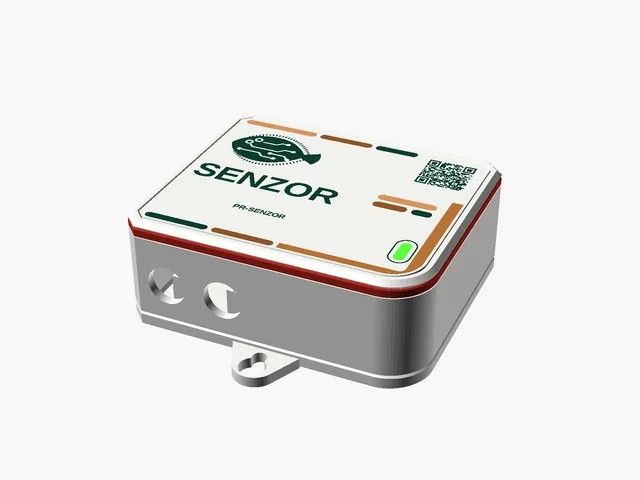

3D design of the enclosure, which you can also print yourself. The product is not manufactured yet, the design may change after the first test prints.
Connect to Home Assistant in three steps
Insert the cell
Take the lid off (two screws on the underside) and insert an 18650 cell. The status LED is on and the device waits 5 minutes for WiFi setup.
Set up WiFi over Improv
Over a USB-C cable from Chrome or Edge, or over Bluetooth from Home Assistant. You confirm Bluetooth pairing by pressing the BOOT button on the board.
Adopt it and set the threshold
Home Assistant finds the device through the ESPHome integration. Set threshold and hysteresis, close the lid and fix the air sensor in the shade at plant height. Attach a phone notification to the alert.
Frost shows up where you do not expect it
One late spring frost can wipe out seedlings you have been raising since February, and the forecast often does not see it coming. Official temperature is measured at 2 m, but on clear, calm nights the ground and the air right above it cool fastest. The difference between 2 m and leaf height can be several degrees, which is how ground frost hits while the forecast says +3 °C. The reliable way is to measure where the plants actually are. That is what Senzor does with its SHT40 air sensor and the Frost warning entity.
Protecting seedlings and blossom
Warm season crops such as tomatoes, peppers, cucumbers, courgettes and basil do not tolerate frost at all, and some suffer a few degrees above zero. Fruit trees and strawberries lose their blossom. Protection is usually simple: fleece, bringing pots indoors, closing a cold frame. You just need to know in time, in the evening or during the night, not in the morning when the leaves have turned glassy.
Why hysteresis matters
An alert that only compares temperature to a threshold flaps on and off when the reading hovers around it, and your phone buzzes all night. Senzor uses a binary sensor with hysteresis: on below the threshold, off only once the temperature climbs back above it by a set margin. Both values live in Home Assistant, and you attach whatever you like: a phone notification, a light in the kitchen, or a heating cable in the cold frame.
Where to put it
Put the air sensor at plant height, on a stake between beds or next to your most sensitive plants, in the shade and under a small roof or radiation shield. Keep the box out of direct sun. The cables come already connected, you do not thread anything. Low spots and open areas under a clear sky are the coldest, while the house wall or a tree canopy stays warmer. Measure in the colder spot.
The battery life is a calculated estimate, not a measurement: about 6 months on a 3000 mAh 18650 cell at a 15 minute interval and room temperature, noticeably less in frost. The calculation is in the manual. The cell is not included and is charged indoors only, never below 0 °C. The easiest way is to keep a charged spare and swap it.
Senzor costs 1 090 CZK, is on pre-order and ships to Czechia and Slovakia via Packeta once the first batch is made.
What is in the box
- Jádro in a PETG enclosure with a TPU seal ring and a printed lid
- SHT40 air temperature and humidity sensor on a cable
- Stainless DS18B20 probe, 30 cm long, on a 1 m cable (compost, soil)
- Both cables routed through glands and connected inside the enclosure at the factory
- 18650 cell holder wired inside the enclosure (cell not included)
- Link to the manual and source files
Specifications
| Product code | PR-SENZOR |
|---|---|
| Alert | binary sensor with hysteresis |
| Threshold and hysteresis | set from Home Assistant |
| Air sensor | SHT40 (temperature, humidity), drives the alert |
| Probe | DS18B20, stainless, 30 cm, 1 m cable (compost, soil) |
| Power | 18650 Li-ion cell in a holder inside the enclosure (cell not included), charged over USB-C under the lid or by swapping the cell |
| Battery operation | deep sleep, adjustable interval |
| Battery life | calculated estimate about 6 months at a 15 min interval (3000 mAh cell, room temperature) |
| Firmware | ESPHome, MIT licence |
| Enclosure | PETG, TPU seal ring, UV-printed lid |
| Warranty | 24 months |
| Price | 1 090 CZK |
FAQ
What threshold should I use?
For tender seedlings like tomatoes, peppers, cucumbers or basil, around +2 to +3 °C at plant height gives you time to react. Hardier plants can take more.
Why does it disagree with the forecast?
Forecasts and weather stations report air temperature at 2 m. On clear, still nights it is colder near the ground, so ground frost can happen while the forecast says a few degrees above zero.
What is hysteresis?
The gap between the on and off temperatures. With a 2 °C threshold and 1 °C hysteresis, the alert turns on below 2 °C and off only above 3 °C.
Is this a different product from Senzor?
No, it is the same Senzor. The alert uses the SHT40 air sensor, the 30 cm probe in the box is there for compost or soil.
How long does the battery last?
The battery is not included, you put a common 18650 cell into the holder. By calculation, not measurement, a 3000 mAh cell lasts about 6 months at a 15 minute interval and room temperature. Noticeably less below freezing, which is exactly frost season. A charged spare swaps in within a minute, charge indoors only, never below 0 °C.
Do you ship outside the Czech Republic?
We ship to Czechia and Slovakia via Packeta, other EU countries on request. It is on pre-order and ships once the first batch is produced.
Docs and source files
Device documentation · Firmware from the browser · How it works
You might also like
Senzor: a garden temperature sensor for Home Assistant
Senzor measures temperature with a stainless DS18B20 probe plus air temperature and humidity with an SHT40. Use it in a compost heap, as a
A greenhouse thermometer for Home Assistant
Senzor measures air temperature and humidity at plant height in your greenhouse with an SHT40. Home Assistant shows when it is time to
A compost thermometer that shows the composting phase
Senzor with a long stainless probe measures the temperature in the core of your compost heap and assigns it to a band based on the