
Jádro: an ESP32-C6 base board for ESPHome sensors
Jádro (Czech for core) is the ESP32-C6 board that every Plošná ryba device is built on. We also sell it on its own for makers who want to build their own ESPHome sensor for Home Assistant.
- Works with Home Assistant
- Open source
- No cloud
A pre-order costs nothing. You pay after we e-mail you that your device from the first batch is ready to ship, and you can cancel until then.

Illustration of use. Photos will follow from the first batch. See the enclosure
How it works and how it connects

- The head connector is a keyed 6-pin JST-PH, one head at a time: ultrasonic sensor, load cells with HX711, LED ring or temperature probe.
- Two Qwiic connectors for I2C sensors and displays without soldering, for example an SHT40.
- USB-C provides 5 V power, firmware upload from the browser and logs.
- A 2-pin JST-PH battery connector for the 18650 cell holder; the board charges the cell, measures its voltage and has reverse polarity protection.
- Over WiFi the board joins Home Assistant as an ESPHome device.
What it will look like

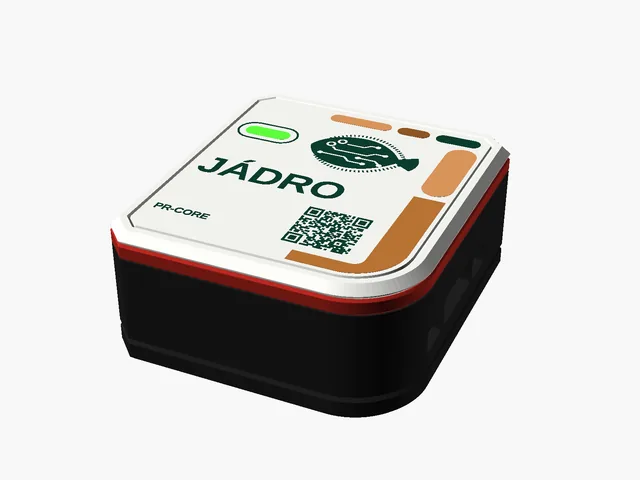

3D design of the enclosure, which you can also print yourself. The product is not manufactured yet, the design may change after the first test prints.
Connect to Home Assistant in three steps
Plug it into USB-C
Connect Jádro to your computer or a USB charger. The status LED stays on while the board waits for WiFi setup.
Flash and set up WiFi
Flash the default firmware from your browser and enter your WiFi credentials over Improv, by USB-C cable or over Bluetooth from Home Assistant confirmed with the BOOT button. Your own config can be pushed later from the ESPHome Builder add-on.
Adopt it in Home Assistant
Home Assistant discovers the board through the ESPHome integration. Confirm it and you will see battery voltage, the status LED and every sensor in your config.
One board, many heads
Every Plošná ryba device shares the same foundation. The only thing that changes is the head, meaning whatever is plugged into the board. Hladina has an ultrasonic sensor, Úl has load cells and an HX711, Spot has an LED ring and an OLED. That gives every box the same power circuit, the same WiFi onboarding and the same ESPHome firmware with a different config.
We sell Jádro on its own too. It is for you if you want to build an ESPHome sensor without designing yet another battery charger, voltage divider and connector layout from scratch.
What is on the board
The heart is an ESP32-C6-WROOM-1 module with WiFi 6, Bluetooth LE and an 802.15.4 radio. Power comes from USB-C or an optional 5 V screw terminal. A Li-ion charger with a JST-PH connector takes an 18650 cell holder, the board measures the cell voltage and is protected against reversed polarity.
Two Qwiic (Stemma QT) ports let you plug in I2C breakouts without soldering. The 6-pin JST-PH head connector carries GND, 3V3, 5V and three GPIOs. There is a single-colour status LED and BOOT and RESET buttons. The whole thing fits in 50 x 40 mm with two M2.5 mounting holes.
The head connector is an open specification, much like the expansion cards of Framework laptops. It is described in hardware/heads/SPEC.md in the repository, so anyone can build their own head. Heads and spare parts (lids, gaskets, cable glands, cables) will also be sold separately.
Working with it
Flash the default firmware from a browser and set up WiFi over Improv. From there it is a regular ESPHome device: write your YAML in ESPHome Builder, push it over the air and the new entities show up in Home Assistant. If you do not run Home Assistant, the device has a local web UI and optional MQTT. On battery you can use deep sleep: wake up, measure, report, sleep again. That is exactly how our Hladina and Senzor work.
Open and repairable
We publish the schematic, PCB and 3D models. Hardware is licensed under CERN-OHL-P-2.0, firmware under MIT and documentation under CC BY 4.0. Modify it, build your own, or use it as a starting point for your project. No cloud, no app, and it keeps working on a network without internet access.
Jádro is 690 CZK and available for pre-order. We are a small Czech team, we ship to Czechia and Slovakia via Packeta (other EU countries on request), and orders go out once the first batch is produced.
What is in the box
- Jádro board, assembled and tested
- Link to the schematic, PCB files and example ESPHome configs
Specifications
| Product code | PR-CORE |
|---|---|
| Module | ESP32-C6-WROOM-1 |
| Radios | WiFi 6 (2.4 GHz), Bluetooth LE, IEEE 802.15.4 (Thread, Zigbee) |
| Power | USB-C 5 V, optional 5 V screw terminal |
| Battery | Li-ion charger, JST-PH connector for an 18650 holder, reverse polarity protection |
| Battery monitoring | cell voltage via divider to ADC |
| Expansion | 2x Qwiic / Stemma QT (I2C) |
| Head connector | 6-pin JST-PH: GND, 3V3, 5V, 3x GPIO, open specification |
| Indicator | status LED (single colour) |
| Buttons | BOOT, RESET |
| Size | max. 50 x 40 mm |
| Mounting | 2x M2.5 holes |
| Licences | hardware CERN-OHL-P-2.0, firmware MIT, docs CC BY 4.0 |
| Warranty | 24 months |
| Price | 690 CZK |
FAQ
Does ESPHome support the ESP32-C6?
Yes. ESPHome supports the ESP32-C6 with the ESP-IDF framework. We will publish example configs for Jádro together with the schematic.
What can I connect?
Anything on I2C through the two Qwiic ports, such as an SHT40, BME280 or a small display, without soldering. The head connector gives you three GPIOs plus 3.3 V and 5 V, enough for UART, 1-Wire or addressable LEDs.
Does it do Thread or Zigbee?
The ESP32-C6 has an 802.15.4 radio, so the hardware can do Thread and Zigbee. Our default firmware for version 1 uses WiFi. There is no LoRa or LTE on the board.
Can it run on a battery?
Yes. There is a Li-ion charger and a JST-PH connector for an 18650 cell holder, with reverse polarity protection. The board measures cell voltage and reports it to Home Assistant.
Do you ship outside the Czech Republic?
We ship to Czechia and Slovakia via Packeta. For other EU countries, e-mail us at info@plosnaryba.cz and we will find a way. Prices are in Czech koruna (CZK).
When will it ship?
Jádro is available for pre-order. We ship once the first production batch is made and will let you know the date by e-mail.
Docs and source files
Device documentation · Firmware from the browser · How it works
You might also like
Hladina: a rain water tank level sensor for Home Assistant
Hladina (Czech for water surface) measures the distance to the water in a tank or well with an ultrasonic sensor and converts it to litres
Senzor: a garden temperature sensor for Home Assistant
Senzor measures temperature with a stainless DS18B20 probe plus air temperature and humidity with an SHT40. Use it in a compost heap, as a
Úl: a WiFi beehive scale for Home Assistant
Úl (Czech for beehive) weighs the whole hive on four load cells and measures temperature and humidity inside. It reports over WiFi to Home