
A compost thermometer that shows the composting phase
Senzor with a long stainless probe measures the temperature in the core of your compost heap and assigns it to a band based on the composting phase. Home Assistant shows whether the heap is heating up, sanitising or cooling down and ready to turn.
- Works with Home Assistant
- Open source
- No cloud
For this use case you need the Senzor temperature probe device.
A pre-order costs nothing. You pay after we e-mail you that your device from the first batch is ready to ship, and you can cancel until then.

Illustration of use. Photos will follow from the first batch. See the enclosure
How it works and how it connects

- A stainless probe measures temperature in the middle of the compost or in the soil, and an SHT40 sensor measures air temperature and humidity at plant height.
- Both cables run through cable glands into the box: the probe into the keyed 6-pin JST-PH connector, the air sensor into a Qwiic connector.
- Inside the box is the Jádro board with an 18650 cell; it sleeps between readings.
- Readings go over WiFi to Home Assistant at home, no cloud.
- A frost warning on your phone, a temperature chart, and an alert when the compost overheats.
What it will look like

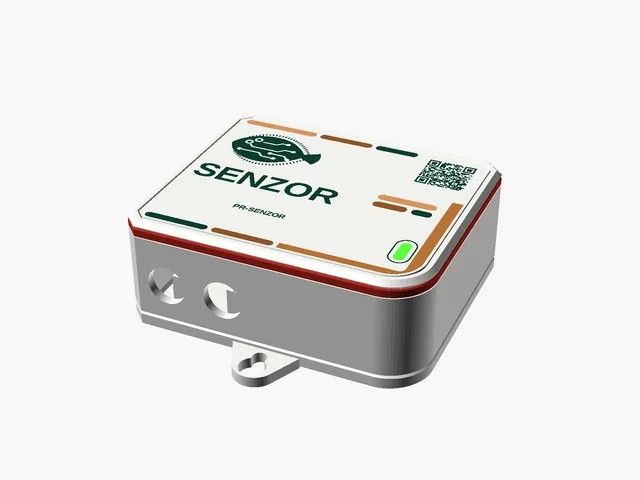

3D design of the enclosure, which you can also print yourself. The product is not manufactured yet, the design may change after the first test prints.
Connect to Home Assistant in three steps
Insert the cell
Take the lid off (two screws on the underside) and insert an 18650 cell. The status LED is on and the device waits 5 minutes for WiFi setup.
Set up WiFi over Improv
Over a USB-C cable from Chrome or Edge, or over Bluetooth from Home Assistant. You confirm Bluetooth pairing by pressing the BOOT button on the board.
Adopt it and push the probe in
Home Assistant finds the device through the ESPHome integration. Set an interval, the 20, 40, 55 and 70 °C bands are preset. Close the lid and push the probe into the middle of the heap.
Why measure compost temperature
Temperature is the easiest way to see what is happening in a compost heap. Microbes do the work and release heat as they go. A warm heap is a working heap. A falling temperature means they are running out of easy food, air or water. A few weeks of readings tell you when to turn, when to water and when to leave it alone. Senzor with its probe in the heap logs that curve in Home Assistant for you.
The phases behind 20, 40, 55 and 70 °C
Below 20 °C. Cold. Either just started, maturing, or stalled. Normal in winter.
20 to 40 °C, mesophilic. Decomposition starts. Microbes that like moderate temperatures break down sugars and other easy material. With enough nitrogen-rich input, temperature climbs within days.
40 to 55 °C, entering the hot phase. Thermophilic microbes take over and the heap visibly shrinks.
55 to 70 °C, sanitising. The important band. A few days here kills most weed seeds and pathogens. To treat the whole volume, turn the heap so the outer layers pass through the hot core.
Above 70 °C. Too hot. Useful microbes die off and decomposition actually slows. Turn or shrink the heap.
After that the compost cools and matures, and worms and fungi move in.
In Home Assistant
The band is exposed as its own entity, which makes automations easy: an alert above 70 °C, or a reminder to turn the heap once it drops below 40 °C after the hot phase. The SHT40 measures the air next to the box, so you see how much warmer the heap is than its surroundings, a good sign of whether it is really working or just following the weather.
Installation
Push the probe into the middle of the heap. Its 1 m cable comes already connected inside the enclosure, you do not thread anything. Mount the box on a stake or the side of the bin in the shade, out of direct rain. It runs on an 18650 Li-ion cell, which is not included. By calculation (not measurement) a 3000 mAh cell lasts about 6 months at a 15 minute interval, less in frost, see the manual. Charge it by swapping the cell, or over USB-C under the lid indoors.
Senzor costs 1 090 CZK, is on pre-order and ships to Czechia and Slovakia via Packeta once the first batch is made.
What is in the box
- Jádro in a PETG enclosure with a TPU seal ring and a printed lid
- Stainless DS18B20 probe, 30 cm long, on a 1 m cable
- SHT40 air temperature and humidity sensor
- Both cables routed through glands and connected inside the enclosure at the factory
- 18650 cell holder wired inside the enclosure (cell not included)
- Link to the manual and source files
Specifications
| Product code | PR-SENZOR |
|---|---|
| Probe | DS18B20, stainless, 30 cm, 1 m cable |
| Compost bands | below 20, 20 to 40, 40 to 55, 55 to 70, above 70 °C |
| Air sensor | SHT40 (temperature, humidity) |
| Power | 18650 Li-ion cell in a holder inside the enclosure (cell not included), charged over USB-C under the lid or by swapping the cell |
| Battery operation | deep sleep, adjustable interval |
| Battery life | calculated estimate about 6 months at a 15 min interval (3000 mAh cell, room temperature) |
| Firmware | ESPHome, MIT licence |
| Enclosure | PETG, TPU seal ring, UV-printed lid |
| Warranty | 24 months |
| Price | 1 090 CZK |
FAQ
How deep should the probe go?
As close to the centre of the heap as possible. In a small bin, push the whole 30 cm in from the side or top. In a large heap, measure from the side at half height.
What temperature should compost reach?
In the hot phase, 55 to 70 °C for several days kills most weed seeds and pathogens. Above 70 °C useful microbes start to suffer and the heap needs air.
My compost sits at 25 °C. Is something wrong?
Not necessarily. Small or gradually filled bins often stay in the mesophilic range and break down slowly. More fresh green material, moisture and turning help it heat up.
Is this a different product from Senzor?
No, it is the same Senzor with the same 30 cm probe. For compost you use the probe temperature and the Compost state entity, which sorts readings into bands.
How long does the battery last?
By calculation, not measurement, a 3000 mAh 18650 cell lasts about 6 months at a 15 minute interval and room temperature. Noticeably less below freezing, a longer interval gives a proportionally longer life. The calculation is in the manual.
Is a battery included?
No. The enclosure has a wired holder for a common 18650 Li-ion cell with 2500 to 3500 mAh from a known brand (button top or flat top). Buy from a reputable seller, cells labelled 9900 mAh are fakes. A cell inserted the wrong way round does no harm, the device just does not start.
Do you ship outside the Czech Republic?
We ship to Czechia and Slovakia via Packeta, other EU countries on request. It is on pre-order and ships once the first batch is produced.
Docs and source files
Device documentation · Firmware from the browser · How it works
You might also like
Senzor: a garden temperature sensor for Home Assistant
Senzor measures temperature with a stainless DS18B20 probe plus air temperature and humidity with an SHT40. Use it in a compost heap, as a
A garden frost alert measured right at plant level
Senzor with the SHT40 air sensor measures temperature at plant height and turns on a frost alert in Home Assistant when it drops below your
A greenhouse thermometer for Home Assistant
Senzor measures air temperature and humidity at plant height in your greenhouse with an SHT40. Home Assistant shows when it is time to