
A greenhouse thermometer for Home Assistant
Senzor measures air temperature and humidity at plant height in your greenhouse with an SHT40. Home Assistant shows when it is time to ventilate and how low the temperature drops at night.
- Works with Home Assistant
- Open source
- No cloud
For this use case you need the Senzor temperature probe device.
A pre-order costs nothing. You pay after we e-mail you that your device from the first batch is ready to ship, and you can cancel until then.

Illustration of use. Photos will follow from the first batch. See the enclosure
How it works and how it connects

- A stainless probe measures temperature in the middle of the compost or in the soil, and an SHT40 sensor measures air temperature and humidity at plant height.
- Both cables run through cable glands into the box: the probe into the keyed 6-pin JST-PH connector, the air sensor into a Qwiic connector.
- Inside the box is the Jádro board with an 18650 cell; it sleeps between readings.
- Readings go over WiFi to Home Assistant at home, no cloud.
- A frost warning on your phone, a temperature chart, and an alert when the compost overheats.
What it will look like

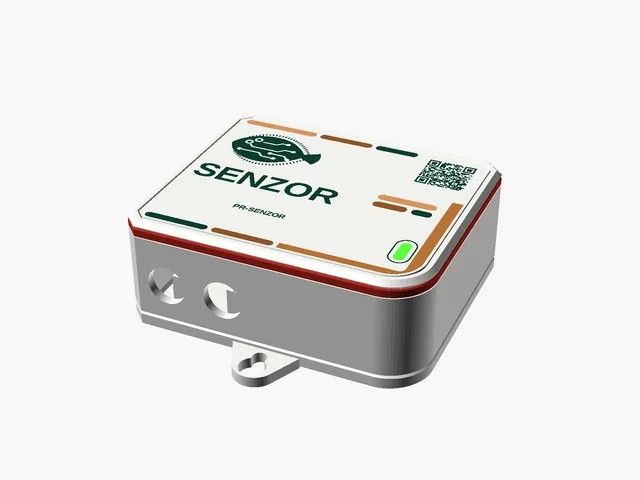

3D design of the enclosure, which you can also print yourself. The product is not manufactured yet, the design may change after the first test prints.
Connect to Home Assistant in three steps
Hang it in the greenhouse
Take the lid off (two screws on the underside) and insert an 18650 cell. The status LED is on and the device waits 5 minutes for WiFi setup. Then hang the box in the shade in the middle of the greenhouse and put the air sensor at plant height.
Set up WiFi over Improv
Over a USB-C cable from Chrome or Edge, or over Bluetooth from Home Assistant. You confirm Bluetooth pairing by pressing the BOOT button on the board.
Adopt it in Home Assistant
Home Assistant finds the device through the ESPHome integration. Use air temperature and humidity in automations for ventilation and the night minimum.
Greenhouses overheat faster than you think
A greenhouse is a heat trap. On a sunny spring day the inside can climb tens of degrees above the outside temperature within a morning, even when it is cold out. Plants suffer, tomatoes set fruit poorly in the heat and leaves can scorch. At night it is the opposite: glass and polycarbonate hold little heat and the inside drops towards the outside temperature.
A glance at a thermometer in the morning is not enough. What matters is the daily curve and especially its extremes. Senzor logs them in Home Assistant.
Ventilating by temperature and humidity
The SHT40 measures both air temperature and relative humidity. Above roughly 28 to 30 °C most vegetables want ventilation. High humidity is the second signal: if it stays high and the night turns cold, leaves get wet and fungal diseases thrive. Set your limits in Home Assistant and get a notification when the greenhouse is overheating with the vents closed, or let an automation drive a fan or vent opener directly.
Night temperatures
The SHT40 sits at plant height, where the temperature matters to the plants. In spring, with freshly transplanted seedlings inside, you want to know when it approaches the point where you would add heat or fleece. In autumn you see how long it still makes sense to keep tomatoes and peppers going. A few weeks of history also show how the greenhouse behaves: how fast it warms up, when it starts to cool and how much warmer than outside it stays overnight.
Installation
Hang the box in the shade in the middle of the greenhouse, never in direct sun. The shade matters for the box too: it is printed in white PETG, which becomes brittle in sun over time and softens around 70 to 80 °C. It runs on a common 18650 Li-ion cell, which is not included. By calculation (not measurement) it lasts about 6 months at a 15 minute interval, see the manual. Charge it by swapping the cell, or over USB-C under the lid.
Senzor costs 1 090 CZK, is on pre-order and ships to Czechia and Slovakia via Packeta once the first batch is made.
What is in the box
- Jádro in a PETG enclosure with a TPU seal ring and a printed lid
- SHT40 air temperature and humidity sensor on a cable
- Stainless DS18B20 probe, 30 cm long, on a 1 m cable (compost, soil)
- Both cables routed through glands and connected inside the enclosure at the factory
- 18650 cell holder wired inside the enclosure (cell not included)
- Link to the manual and source files
Specifications
| Product code | PR-SENZOR |
|---|---|
| Air sensor | SHT40 (temperature, relative humidity) |
| Probe | DS18B20, stainless, 30 cm, 1 m cable (soil or compost temperature) |
| Outputs | air temperature, humidity, probe temperature, battery voltage |
| Power | 18650 Li-ion cell in a holder inside the enclosure (cell not included), charged over USB-C under the lid or by swapping the cell |
| Battery operation | deep sleep, adjustable interval |
| Battery life | calculated estimate about 6 months at a 15 min interval (3000 mAh cell, room temperature) |
| Firmware | ESPHome, MIT licence |
| Enclosure | PETG, TPU seal ring, UV-printed lid |
| Warranty | 24 months |
| Price | 1 090 CZK |
FAQ
Where should it go?
The box with the SHT40 in the shade, ideally in the middle of the greenhouse at plant height, never in direct sun or it will measure heated air instead of the real temperature. You can push the probe into a bed to measure soil temperature.
Can it open the vents?
Senzor does not switch anything itself, but Home Assistant can use its readings to run a fan or a motorised vent opener.
What temperature should a greenhouse have?
It depends on the crop. For tomatoes and peppers, roughly 20 to 28 °C during the day is fine and nights should not drop much below 12 °C. Above 30 °C it is usually time to ventilate.
Why measure humidity?
Long periods of high humidity followed by a cold night lead to wet leaves and favour fungal diseases such as blight. Humidity tells you to ventilate even when the temperature looks fine.
How long does the battery last?
By calculation, not measurement, a 3000 mAh 18650 cell lasts about 6 months at a 15 minute interval and room temperature. Noticeably less below freezing, a longer interval gives a proportionally longer life. The calculation is in the manual.
Do you ship outside the Czech Republic?
We ship to Czechia and Slovakia via Packeta, other EU countries on request. It is on pre-order and ships once the first batch is produced.
Docs and source files
Device documentation · Firmware from the browser · How it works
You might also like
Senzor: a garden temperature sensor for Home Assistant
Senzor measures temperature with a stainless DS18B20 probe plus air temperature and humidity with an SHT40. Use it in a compost heap, as a
A garden frost alert measured right at plant level
Senzor with the SHT40 air sensor measures temperature at plant height and turns on a frost alert in Home Assistant when it drops below your
A compost thermometer that shows the composting phase
Senzor with a long stainless probe measures the temperature in the core of your compost heap and assigns it to a band based on the