
Úl: a WiFi beehive scale for Home Assistant
Úl (Czech for beehive) weighs the whole hive on four load cells and measures temperature and humidity inside. It reports over WiFi to Home Assistant, where you see weight, daily gain and their history.
- Works with Home Assistant
- Open source
- No cloud
A pre-order costs nothing. You pay after we e-mail you that your device from the first batch is ready to ship, and you can cancel until then.

Illustration of use. Photos will follow from the first batch. See the enclosure
How it works and how it connects

- Four load cells in printed legs under the hive corners weigh the whole hive, and an SHT40 sensor inside measures temperature and humidity.
- The cables run through cable glands into the box: the load cells through the HX711 converter with a keyed 6-pin JST-PH plug, the SHT40 sensor into a Qwiic connector.
- Inside the box is the Jádro board, powered with 5 V from any USB charger, no battery.
- Data goes over WiFi to Home Assistant at home, no cloud.
- A phone alert when the hive suddenly loses weight (a possible swarm) and a weight chart for the whole season.
What it will look like

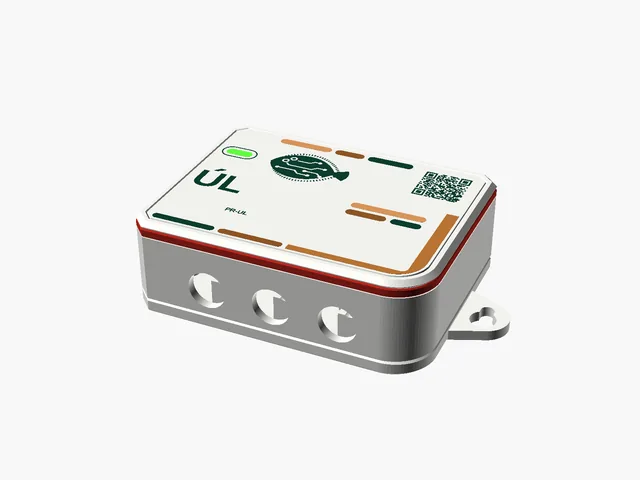

3D design of the enclosure, which you can also print yourself. The product is not manufactured yet, the design may change after the first test prints.
Connect to Home Assistant in three steps
Set up WiFi over Improv
Best done at home: take the enclosure lid off (two screws on the underside) and enter WiFi over a USB-C cable from the browser, or over Bluetooth from Home Assistant confirmed with the BOOT button. Pick a network that reaches the apiary.
Set up the feet and plug it in
Screw the bases to a firm, level surface in a rectangle matching the hive floor, put the load cells into the pockets in the corners and stand the corners on the bases. Put the SHT40 inside the hive and plug the USB-A plug into a USB charger. No soldering.
Adopt and calibrate
Home Assistant finds the scale through the ESPHome integration. Tare the empty scale, put a known weight on it and enter the value. Then put the hive on so the floor corners sit in the cups.
Why weigh a hive
Hive weight is one of the best indicators of what is going on inside, and you cannot see it from outside. Put the hive on four feet with load cells and you know every day how much it gained or lost. During a nectar flow you see whether the bees are bringing in nectar and how much. In autumn you can check whether there are enough stores for winter, and in late winter whether they are running out before spring.
The SHT40 sensor on a thin Qwiic cable goes between boxes or under the lid and reports temperature and humidity inside the hive.
How it is built
The scale stands on four printed feet right under the corners of a wooden hive floor. Each foot is a black base on the ground, a 50 kg half bridge load cell and a white corner with a cup that takes the floor corner, 200 kg in total. No beam is needed across the span, the hive floor does that job. The plastic is only in compression above and below each load cell, so if it settles a little the reading should not change. All four load cells are soldered at the factory to a single HX711 next to Jádro in the enclosure. You do not solder anything: screw the bases to a firm, level surface, put the load cells into the corners, stand the corners on the bases and put the hive on. Polystyrene and plastic floors would bend at the feet, for those there is a variant with corners for two wooden 45 x 45 x 500 mm beams from a DIY store. The scale measures continuously so it can catch the quick drop of a swarm. It has no battery and runs on 5 V: the power cable leaves the enclosure through a gland and ends in a USB-A plug for any USB charger. The enclosure is printed in white PETG, has no external port or buttons and the lid is sealed with a TPU ring. Without power at the apiary, a solar panel with a battery and a USB 5 V output does the job.
In Home Assistant
The scale is adopted through the ESPHome integration with entities for weight, daily gain, change in 15 minutes, temperature and humidity. Calibration happens right in Home Assistant: tare the empty scale, add a known weight, type in the value. No trimmers, no editing constants in firmware.
From there, chart the whole season, or set up an automation that warns you when the hive suddenly loses weight during the day (possibly a swarm) or when autumn weight drops below what you consider safe for winter.
Open and repairable
Firmware is ESPHome under MIT, schematics and PCB under CERN-OHL-P-2.0, and the feet and enclosure models are published. If a load cell fails, replace just that one. Want to weigh more hives? Build another scale from the published files. No cloud, no app, the data stays at home.
Úl costs 2 990 CZK, is available for pre-order and ships to Czechia and Slovakia via Packeta once the first batch is produced.
What is in the box
- Jádro in an enclosure with a printed lid and the HX711 head
- 4 load cells of 50 kg, soldered to the HX711 at the factory and led into the enclosure through a cable gland
- SHT40 sensor on a Qwiic cable to place inside the hive, led into the enclosure through a cable gland
- 5 V power cable led through a cable gland, ending in a USB-A plug for any USB charger
- 4 printed feet for the corners of the hive floor: white corner with a cup and black base
- Wood screws for the bases and the electronics enclosure
- Link to the manual and source files
Specifications
| Product code | PR-UL |
|---|---|
| Load cells | 4x 50 kg half bridge, 200 kg total |
| Amplifier | HX711 |
| Feet | 4 printed in PETG (base, load cell, corner with a cup) right under the corners of a wooden hive floor |
| Polystyrene and plastic floors | variant with 2 wooden beams 45 x 45 x 500 mm, beams not included |
| Hive climate | SHT40 on a Qwiic cable |
| Outputs | weight, daily gain, change in 15 minutes, temperature, humidity |
| Calibration | from Home Assistant: tare and known weight |
| Power | 5 V from any USB charger (cable with a USB-A plug), no battery |
| Chip | ESP32-C6-WROOM-1 (WiFi 6, BLE, Thread) |
| Firmware | ESPHome, MIT licence |
| Warranty | 24 months |
| Price | 2 990 CZK |
FAQ
How heavy a hive can it take?
Four 50 kg load cells give 200 kg in total, which covers common multi-box hives during a nectar flow. Each foot stands on its own right under a floor corner, so you place them to match your hive.
What kind of hive floor does it need?
The default feet are for a stiff wooden floor, which carries the hive between the feet by itself. A polystyrene or plastic floor would bend at the feet, so for those there is a variant with corners for two wooden beams 45 x 45 x 500 mm. Buy the beams at a DIY store (pressure treated or larch), they are not included. Tell us which floor you have in the order note.
Do I need WiFi at the apiary?
Yes, version 1 is WiFi only. If the apiary is far from the house, an outdoor access point or repeater helps. We do not offer LoRa or LTE versions yet.
Does temperature affect the reading?
Load cells drift slightly with temperature, so weight can move a little between day and night. Daily gain measured at the same time each day, for example at night, is the more reliable number.
Can I use it without Home Assistant?
Values are shown in the local web UI and can be sent over MQTT. Calibration, history and alerts are most comfortable in Home Assistant though.
Do you ship outside the Czech Republic?
We ship to Czechia and Slovakia via Packeta. For other EU countries, e-mail us at info@plosnaryba.cz and we will find a way. Prices are in Czech koruna (CZK).
When will it ship?
Úl is on pre-order. We ship once the first production batch is made and will let you know by e-mail.
Docs and source files
Device documentation · Firmware from the browser · How it works
You might also like
Senzor: a garden temperature sensor for Home Assistant
Senzor measures temperature with a stainless DS18B20 probe plus air temperature and humidity with an SHT40. Use it in a compost heap, as a
Jádro: an ESP32-C6 base board for ESPHome sensors
Jádro (Czech for core) is the ESP32-C6 board that every Plošná ryba device is built on. We also sell it on its own for makers who want to
Hladina: a rain water tank level sensor for Home Assistant
Hladina (Czech for water surface) measures the distance to the water in a tank or well with an ultrasonic sensor and converts it to litres